
How to Build a Journaling Ecosystem That Actually Works
A few years ago, I counted the half-finished journals on my desk. Seven. Seven books I had opened with the kind of hope only a Sunday morning and a fresh pen can produce. Seven books that had slowly, quietly, become shelf decoration.
One of them had three weeks of daily entries and then a gap that spanned an entire season of my life. Another held exactly six gratitude lists. A third had been my "business notebook" for about nine days before I decided I needed a different notebook for business, which of course I also abandoned.
I was not a bad journaler. I was trying to run five practices out of one book, or one practice across five books, and neither was working. What I was missing wasn't discipline. It was a system — a journaling ecosystem where each notebook had one clear job and handed off to the next without me having to think about it.
Here's the one I built, the mistakes I made on the way, and how you can design yours without buying anything new.
What a journaling ecosystem actually is
A journaling ecosystem is two or three (or four!) notebooks/planners working together, each with a different role, so that no single book has to be everything to you. The morning brain dump doesn't have to share pages with your goal review. Your travel souvenirs don't have to compete with your weekly plan. Each book knows what it is for, which means you know where to look when you need it.
It's the opposite of the single "perfect journal" fantasy most of us grew up with. And once I stopped chasing the one-book solution, the whole practice got easier, not more complex.
The three jobs every journal does
If you only remember one framework from this post, make it this one. Every journaling practice falls into one of three jobs, and understanding which job you are trying to do tells you which book to open.
Capture is the fast, messy, unfiltered job. Morning pages. Brain dumps. The stray idea that arrives in the shower. Capture books don't need to be pretty — they need to be accessible. You should be able to scrawl in them without thinking.
Process is slower. This is where you sit with a feeling, unpack a decision, or reflect on what a week actually taught you. Process journaling is where the real shifts happen, and it deserves its own quiet book.
Plan is structural. Weekly reviews. Goal tracking. Content calendars. Anything with repeating pages and a sense of forward motion.
Most people try to do all three in one notebook and end up doing none of them well. I did this for a decade before I understood why I kept drifting.
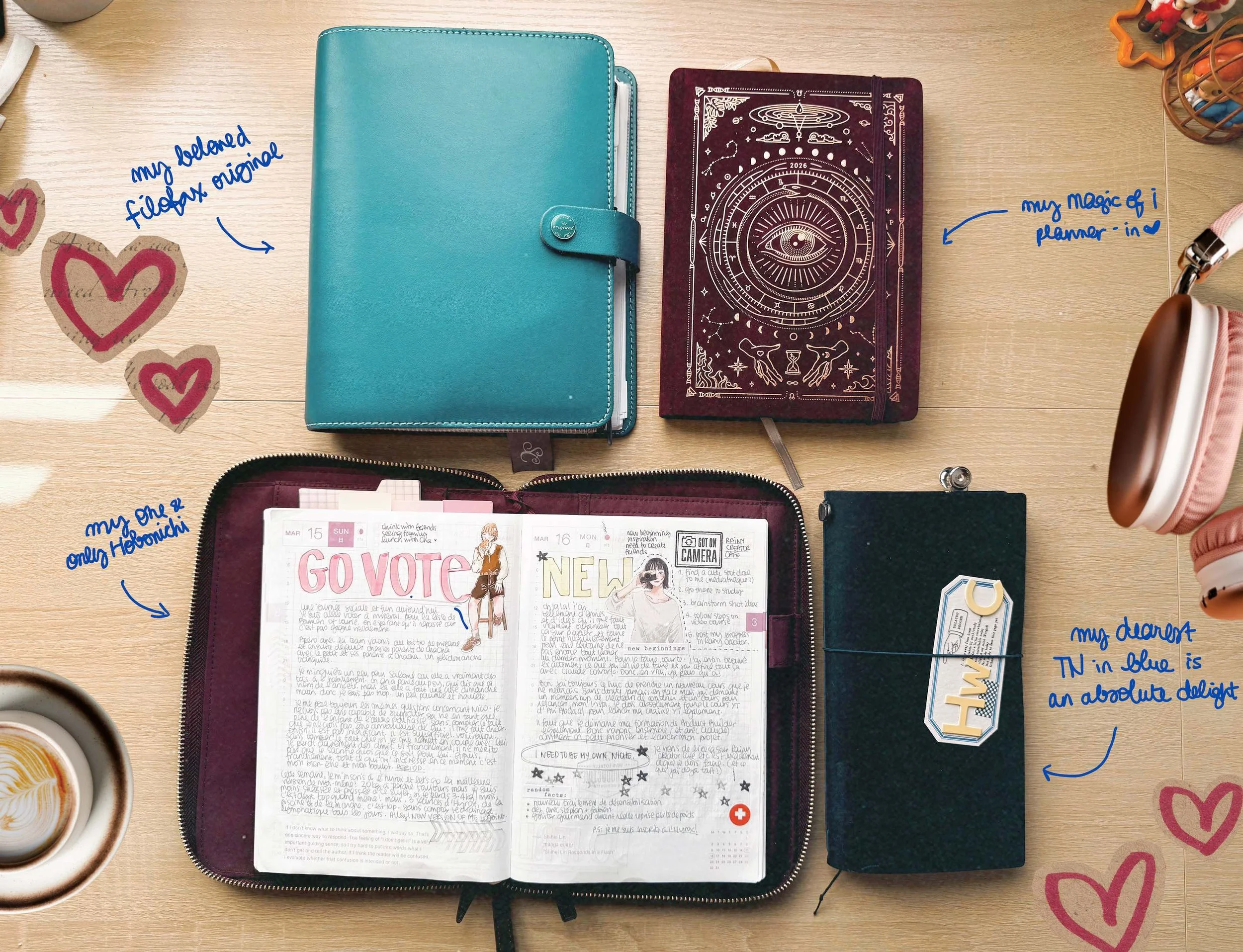
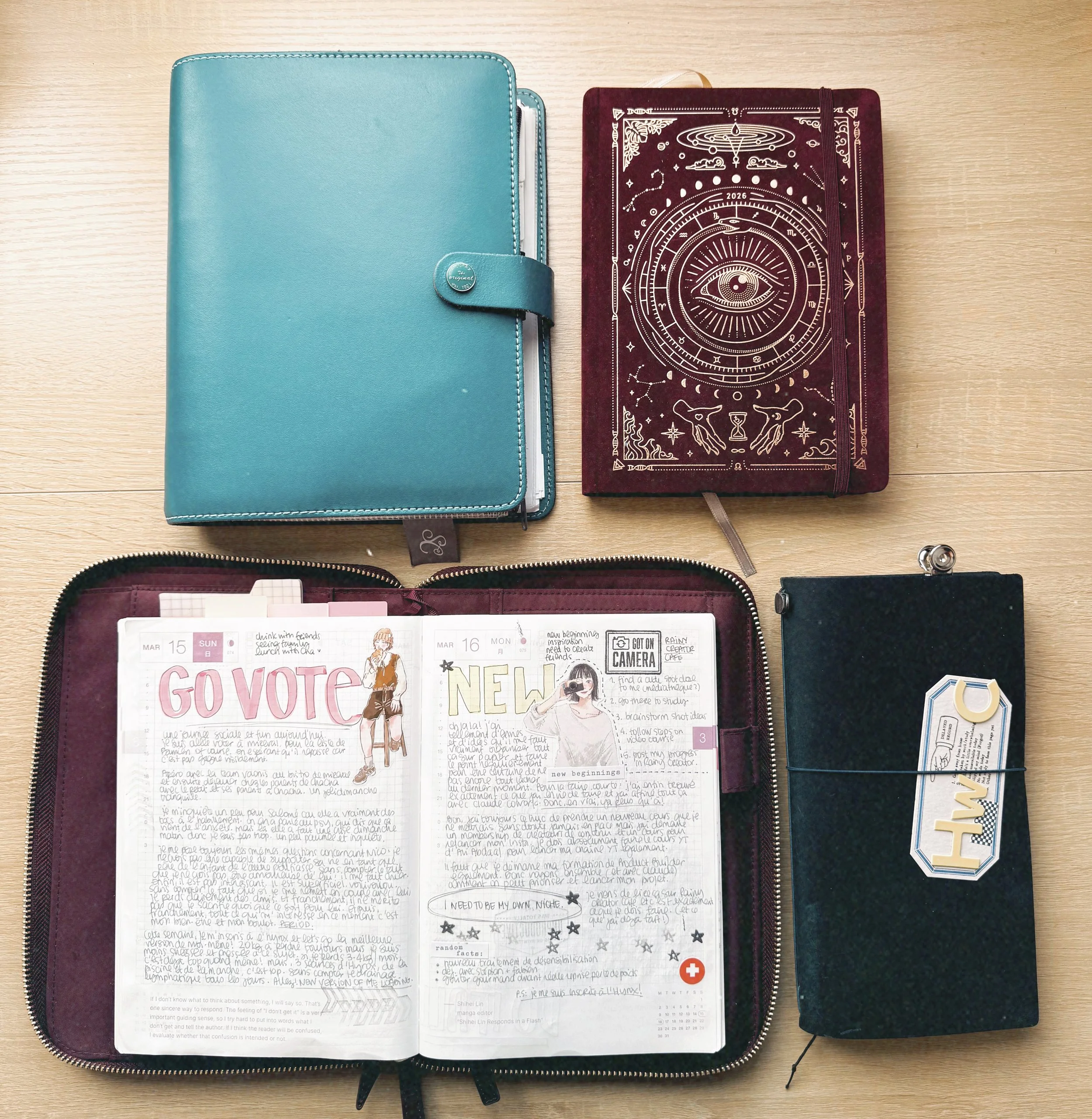
My current four-notebook setup
I know I said three. But actually, I have four. Let me show you what's actually on my desk right now — not the aspirational version, the real one.
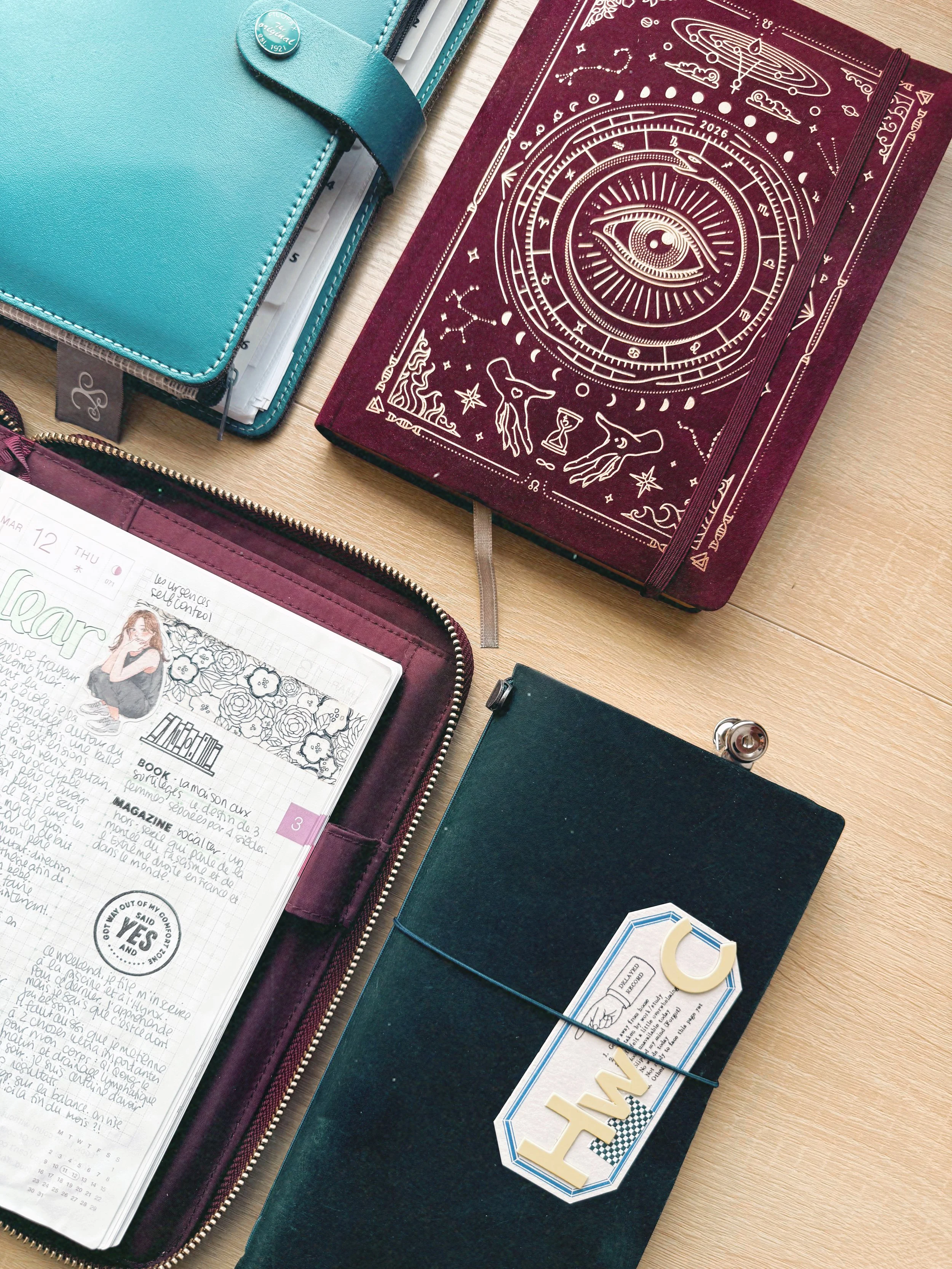
My capture book is my Filofax A5 Original that I refill with custom weekly pages. It's the one I reach for on Sunday evenings when I feel something asking to be sorted through. It travels with me. It's deliberately a little inconvenient, because that friction makes me only write in it when I actually have something to say.
My process book is my Hobonichi Techo Cousin. One page per day, A5, with a tiny grid that somehow makes me feel free rather than restricted. Every morning at 8am, before the rest of the house wakes, I sit with tea and I fill the page. Stream of consciousness. No editing. It's the most honest book I own.
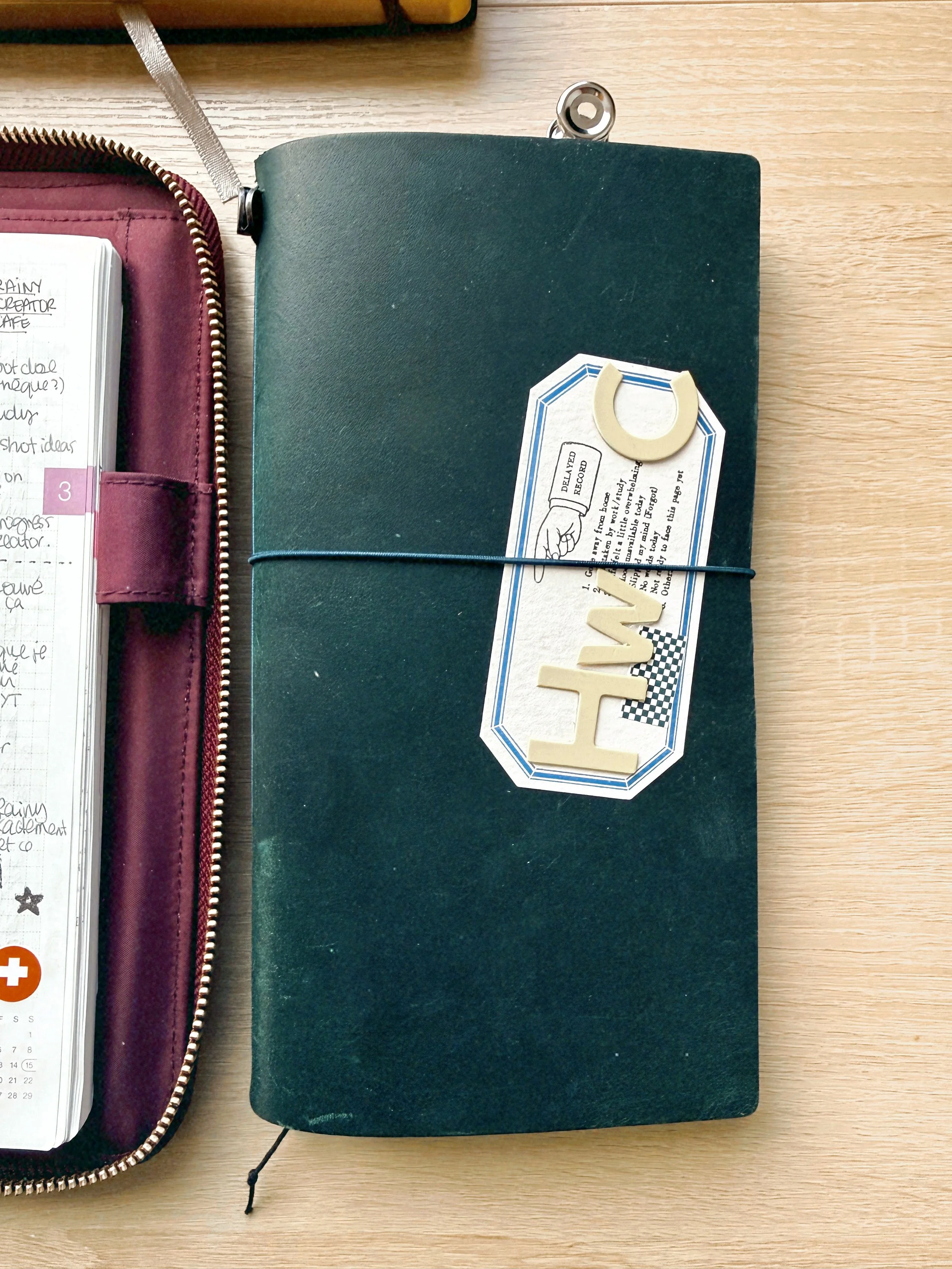
My plan book is my Traveler's Notebook in the regular size, blue cover, lined insert. Weekly review on the left, looking-ahead on the right, and an ideas column for anything that needs to move into a project later. This is the book I open at my desk in work mode.
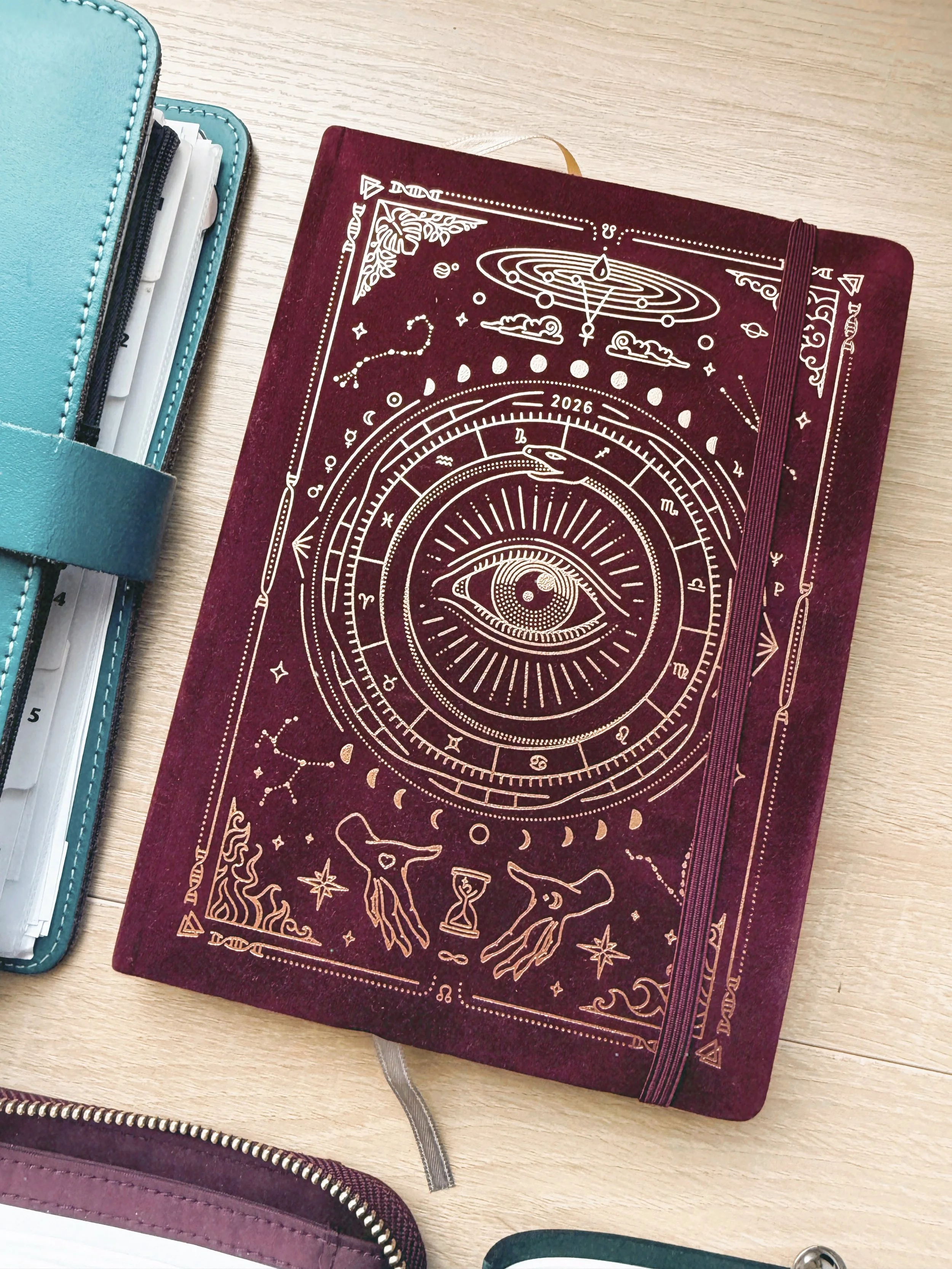
My private book is my Magic Of I notebook. A5, vegan leather, lined pages. Absolute delish paper. In love with Magic of I for years, I do have their Astrological planner for in-depth astrology stuff (if you do believe in astrology, I highly encourage you to check them out or read my previous blogposts about them).
ThFourree books. Four jobs. No overlap.
How to choose your anchor journal first
If you're starting from scratch — or from the pile of half-used books most of us have — don't try to set up all three at once. Pick one.
Your anchor journal is the one you will open every single day, the non-negotiable. For me it's the capture book, because morning pages are how I stay honest with myself. For a friend of mine it's her planner — she's a planner-first woman and her week falls apart without it. For another it's her evening reflection book, two sentences before bed.
Ask yourself this: if you could only keep one journaling practice, which one would you grieve losing? That's your anchor. Build around it only once the anchor is stable for at least four weeks.
Want a gentle place to start?
I made a small free guide called Your First Intentional Page — eleven pages of structured journaling prompts designed to help you start without overthinking. You can grab it here.
The morning handoff between notebooks
Here's the part most ecosystem advice skips: how the books talk to each other.
My flow looks like this. Capture book at 7:30am — whatever's in my head goes on the page, no filtering. As I write, if a real task or a real feeling surfaces, I underline it. Later that morning, at my desk, I open my plan book and transfer the underlined tasks into the weekly page. If a feeling surfaced, I carry it to my process book on Sunday.
Nothing gets written twice in full. The underline is the handoff signal. It takes maybe three minutes and it means my capture book stays a free space while my plan book stays clean and actionable.
If you don't design the handoff, the ecosystem collapses back into chaos within a month. Every book ends up trying to do every job again.
When to add a fourth or fifth book
You probably don't need to, but if you want to, there's a rule. Add a book only when you notice the same type of content showing up in your existing books and feeling out of place.
I have a fifth book — my Magic of I planner — that I use as a seasonal intention book, four times a year, not daily. I added it because my process book kept filling up with long-view reflections that didn't belong next to my weekly emotional check-ins. That was the signal. A new type of content asking for its own home.
I have never added a book because a friend raved about it. I have never added a book because Pinterest suggested I should. The invitation has to come from inside the practice, not from a craving for new stationery. (This is a hard rule. I break it sometimes. The books I break it for almost always end up on the shelf with the other seven.)

The Sunday review that keeps it all working
Once a week, ideally Sunday evening, I do a short review that holds the whole ecosystem together. It takes twenty minutes, not two hours.
I open my capture book and skim the week's pages. I notice patterns — the same worry showing up four times, the same idea circling. I move anything action-worthy to my plan book. I move anything feeling-worthy to my process book. Then I close the capture book and don't re-read those pages again.
In my plan book, I do a simple three-question review. What worked? What dragged? What do I want to protect in the coming week? Three questions, ten minutes, and my plan book is ready to run Monday.
Without this review, everything I write disappears into a stack of pages I'll never re-read. The review is what turns writing into insight.
Paper or digital — the rule I use for each input
I get this question a lot, and my honest answer is: it depends on the input, not the tool.
Anything with emotional weight goes to paper. Always. Research shows handwriting slows the brain down enough to process what you're actually feeling, and my own experience agrees.
Anything with a reference function — a book of ideas I'll want to search later, a database of content, a list that grows — goes digital. I use Notion for this. My plan book captures the week, but the longer content calendar lives in Notion where I can filter and sort.
The rule is simple: handwriting for feeling, digital for retrieval. They're not in competition. They do different jobs.
What to do when your ecosystem stops working
Every system breaks eventually. Mine has broken three times since I set it up, and the reason is always the same — my life changed and the ecosystem didn't.
When I started the HWC blog, my old two-book setup couldn't hold the work. I needed a plan book. When I came back from Japan with a box of stationery and a reignited love for scrapbooking, I needed a creative book. When my daughter started primary school, my morning window shrank and my capture book had to change format.
If yours has stopped working, don't blame yourself. Ask what's changed in your life. The ecosystem is downstream of your season — and redesigning it every year or two is normal, not a sign of failure.
One last thing
You don't need seven journals. You need two or three that know their job, talk to each other, and get closed at the end of the week. Start with one. Let the next one earn its place. Let your books serve the life you're actually building.
And if you've been staring at a shelf of half-used notebooks feeling like you're the problem — you're not. You just haven't met your ecosystem yet.
Fun little disclaimer: some of the links in this post may be affiliate links. If you buy through them, I may earn a small commission at no extra cost to you. It helps support my work, keeps the content coming, and funds my very serious business operations… like coffee and notebooks.