
I Used to Be Creative (And Then I Forgot How to Be)
I want to tell you something I don't say often enough.
I used to create on a daily basis. Badly, slowly, in the margins of everything. I used to print photos, turn them into unforgettable moments, add stickers and glued everything into albums that went on that shelf and meant everything. I used to be the person who had a project going, always — something half-finished on the table, something I was making just because I wanted to. And it used to be my job. For 10 years. I traveled the world to teach scrapbooking. Met thousands of students. Published a book. Had brand deals with so many incredible brands in the papercrafts industry.
And then, gradually, so gradually I didn't notice until it was completely gone — I stopped. I became a mom. And I had other priorities. Funny how I used to scrapbook without a kid and the day I got one : i no longer scrapbooked. pfff.
I told myself the usual things. I'm not actually that creative anymore. I don't have time for that kind of thing. Adults don't just... make things for no reason.
If you're reading this, I suspect you know exactly what I mean.
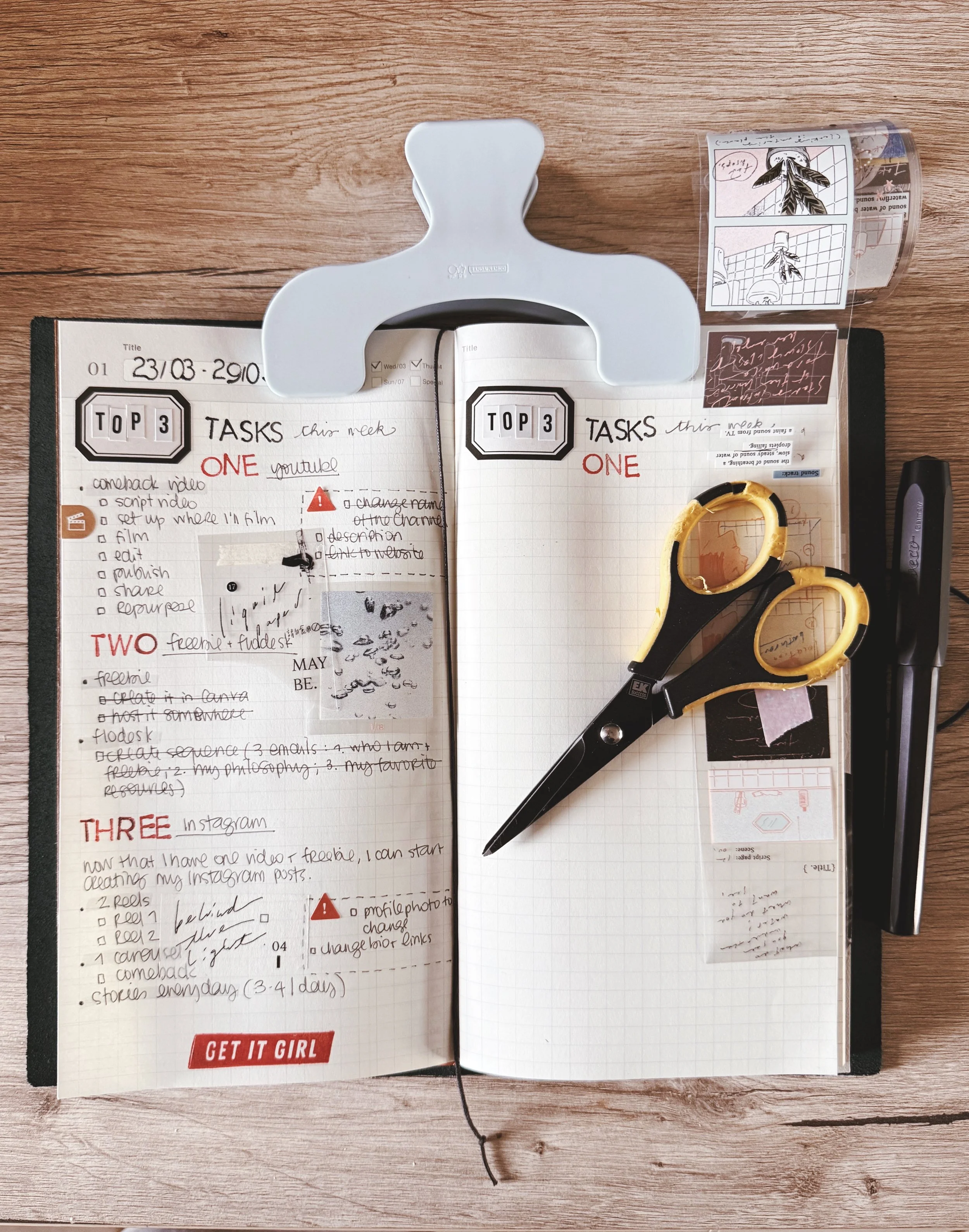
My Traveler’s Notebook helps me focus on my business.
The moment you decided you weren't creative
There's usually a moment. It's rarely dramatic.
Maybe someone looked at something you made and said that's nice in the tone of voice that means the opposite. Maybe you compared your work to someone else's and quietly closed your sketchbook for the last time. Maybe you just got busy — with work, with a relationship, with children (helloooooo!), with life — and creativity was the thing that got quietly sacrificed to make room for everything that felt more urgent.
It happens in small increments. A week without making anything becomes a month. A month becomes a year. And then you're standing in a craft shop picking up a beautiful journal and you put it back on the shelf because you think: I wouldn't even know what to do with that.
Here's what I want to say, very plainly: that decision was not a discovery about yourself. It was a response to circumstances.
You did not find out you weren't creative. You learned to stop.
Why "I'm not creative" is a sentence we learned, not a fact
Creativity — the real kind, not the Instagram kind — is not a talent. It's not a personality type. It's not something you either have or you don't.
It's a practice. And like all practices, it atrophies when you don't use it, and it comes back when you do.
The problem is that somewhere along the way, most of us absorbed a very specific definition of creative: it means producing things that look good, that others can appreciate, that demonstrate visible skill. It means being an artist, a designer, someone who does creative things professionally.
By that definition, most of us aren't creative. By that definition, creativity is something you qualify for.
But there's another definition — older, simpler, less glamorous — where being creative just means making something. Arranging things. Noticing things. Responding to the world through your hands as well as your head.
That kind of creativity doesn't go anywhere. It just gets buried.
What "getting back into it" actually looks like
Not like you think.
It doesn't look like buying a beautiful sketchbook and sitting down to fill it meaningfully. It doesn't look like taking a class, watching tutorials, building a system.
It looks more like this: you find fifteen minutes and you do something slightly stupid and low-stakes. You glue a receipt into a notebook. You write three lines about your morning. You sketch something badly on a Post-it and throw it away. You arrange your desk in a way that makes you feel something.
And nothing happens. It feels awkward and pointless and a little embarrassing.
And then you do it again the next day. And the day after.
The return of creativity is not a revelation. It's a decision you make repeatedly, in small increments, until one day you realise you're someone who makes things again.
I know because I've done it. The first time I sat down to scrapbook again after years of not touching a thing — I felt ridiculous. I had no idea what I was doing. I was forty-something years old, cutting up stickers and masking tape like a child. And then, about twenty minutes in, something shifted. Something in my nervous system went quiet. I was just... there. Present. Making something. And for that, I will always be grateful to Ali Edwards and her One Little Word project because that’s probably thanks to her that I’ve stuck to documenting and scrapboking :)
It was the best I had felt in weeks.
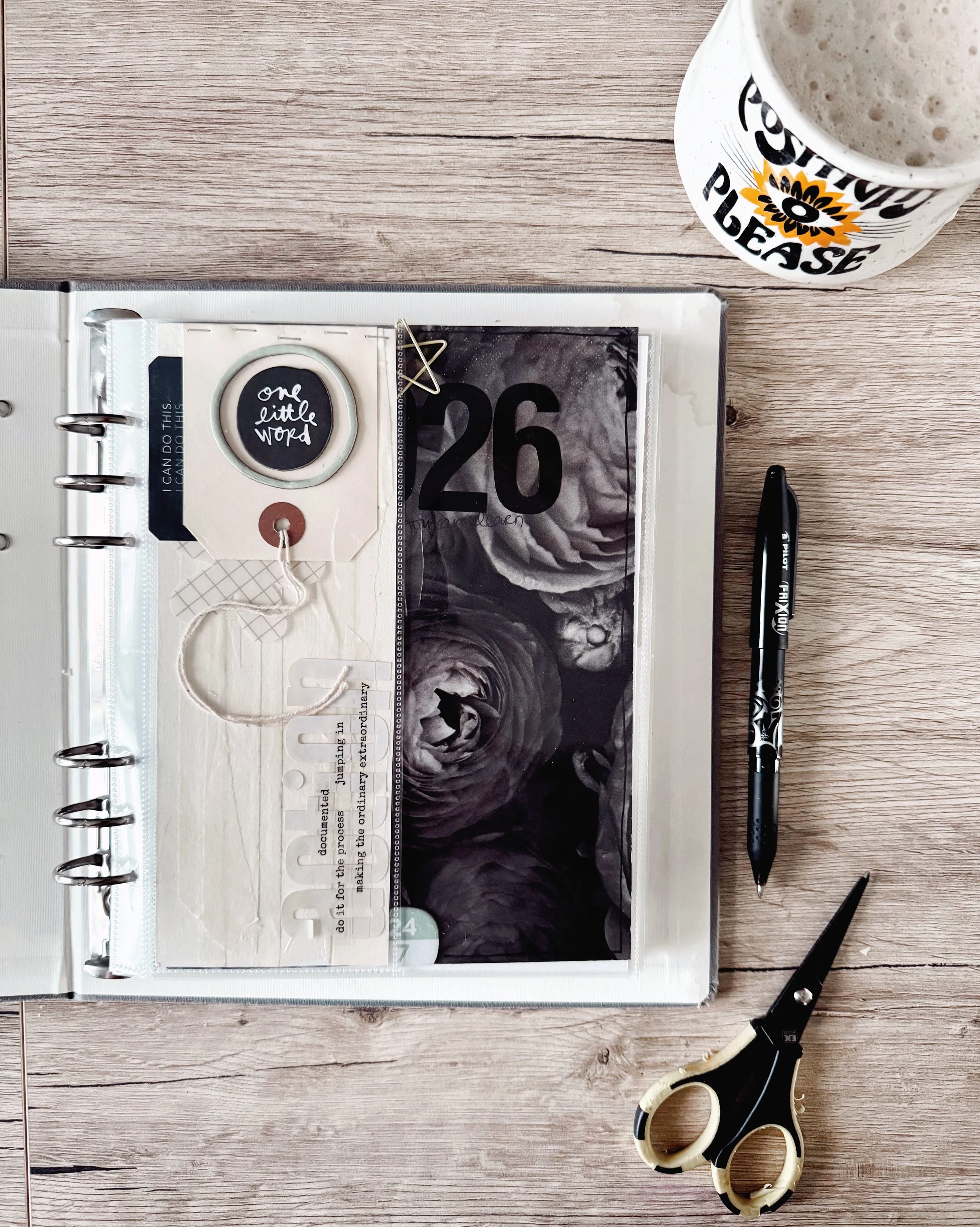
The journal as the easiest possible starting point
Of all the creative practices I've returned to and maintained, journaling is the one I come back to most reliably. And I think it's because it has the lowest barrier of entry possible.
You don't need skill. You don't need supplies. You don't need to know what you're doing before you begin.
You just need a notebook or Hobonichi Techo Cousin or a Magic of I journal a pen and five minutes where you're not needed for anything else.
The journal doesn't ask you to be good. It asks you to be honest. And if you've spent years being competent and useful and reliable for everyone around you, you might find — like I did — that honesty is the rarer and more surprising practice.
What I've noticed after years of daily journaling is that the page trains you to notice things. The colour of morning light. The feeling you had before you could name it. The thought you'd have dismissed in company but write out in full when no one is watching.
That noticing is creativity. It's not glamorous. But it's where everything else comes from.
Three ways to start (that don't require talent or time)
The one-line entry. Every day, one sentence. Just one. It can be a fact ("It rained this morning and I didn't mind"), an observation, or something you want to remember. That's it. That's the whole thing. You are building the habit of noticing.
The memory page. Open to a blank page. Write about something from your past — a trip, a meal, a conversation, a place you loved. No structure required. This is memory-keeping, and it is an entirely valid form of creative practice. Add a photo if you have one. Draw a small sketch if you want to. Leave it imperfect.
The found-object page. Save one small thing this week — a label, a receipt, a leaf, a ticket stub, a piece of washi tape. Stick it on a page. Write three sentences about why you kept it. You have just started scrapbooking. It doesn't need to look like anything in particular.
None of these require you to be creative. All of them will make you more creative, the more you do them.
The part about permission
The most common thing I hear from women who want to start journaling or get back into creative practice is some version of: I don't know if I'm allowed to.
Not in those words. But it's there. In the hesitation. In the feeling that this is frivolous. In the instinct to do it perfectly before doing it at all, which is really an instinct to never do it.
You are allowed to make things that are only for you.
You are allowed to do something that has no output, no deliverable, no measurable result. You are allowed to spend twenty minutes with a notebook and come out of it with nothing but the feeling of having been present for your own life.
That is enough. That is, in fact, a lot.
→ If you want a gentle starting point, I made something for exactly this moment. It's called Your First Intentional Page — a free 11-page guide for the space between "I want to journal" and "I don't know where to begin." Download it here.
You didn't lose your creativity. It's been waiting.
The version of you who used to make things — she's not gone. She's just been waiting for you to give her fifteen minutes and a page she's allowed to mess up.
You don't have to be good at this. You don't have to produce anything worth sharing. You don't have to become a journaling person, or a scrapbooker, or an artist.
You just have to begin. Badly, if necessary. Slowly, if that's what's available.
The creativity comes back. Not all at once, and not without some awkwardness — but it comes.
I've seen it happen. I've lived it happen.
Start with one page.
What's something you used to make or do just for yourself, that you've drifted away from? Tell me in the comments — I'm genuinely curious.